
Arts and Humanities
The Foundation offers a wide variety of cultural experiences through its well-known Arts and Humanities Program. The Foundation offers these programs to the college faculty, staff, and community in a variety of ways. Whether it’s a lecture on the Middle East or a trip to Gettysburg, the Foundation plans several informative and entertaining Arts and Humanities events each semester.
Spring 2026 Series
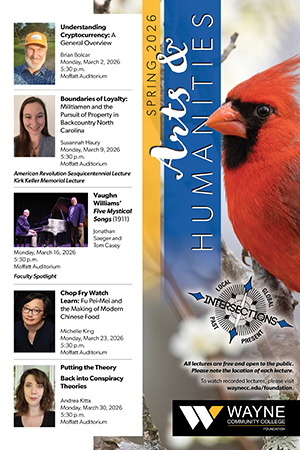
Lectures
Monday, March 2, 2026
Understanding Cryptocurrency: A General Overview
Brian Bolcar
5:30 p.m. in WCC’s Moffatt Auditorium
In our ever-changing world in the digital age, we see a new form of currency that does not rely on banks and not printed by governments. Imagine a currency whose value is unlike traditional currencies. If you are curious to learn more, come and join Brian Bolcar who will conduct an introduction to cryptocurrency followed by a Q&A session. You will leave with a sense of what it is, how it is used, and some of the pros and cons of its usage.
Brian Bolcar is an employee of the North Carolina Investment Authority as a part of the Office of the State Treasurer. His title is Portfolio Manager – Private Equity
Bolcar has a Bachelor of Sciences in Accounting and a MBA in Finance. He also has CFA and CPA certifications.
For the last 20 years, Bolcar has been an investor in the Private Equity asset class, ranging from Venture Capital to Large Buyout managers, direct co-investments and other structures. Since 2018, has been actively interacting with institutional asset management firms in the blockchain and crypto sector.
Monday, March 9, 2026
Boundaries of Loyalty: Militiamen and the Pursuit of Property in Backcountry North Carolina
Susannah Haury
5:30 p.m. in WCC’s Moffatt Auditorium
[Kirk Keller Memorial Lecture]
While history often treats the militias of the American Revolution as static, locally rooted forces, the records of men such as Ensign James Blair, “Killing” Stephen Jackson, Sergeant Peter Herget, and Private William Metcalf suggest a more fluid reality in which militiamen actively remade their identities and communities through service. Why did these men reappear on militia rosters in different states? Was this convenience, compulsion, or something deeper: an intentional search for belonging or advantage during a chaotic war? Ms. Haury’s lecture invites you to investigate the role of Revolutionary War militiamen who moved across southern state lines—Virginia, North Carolina, South Carolina, and Georgia—and what their patterns of movement and repeated enlistment reveal about the nature of militia service and community formation in the southern backcountry.
Susannah Haury is a doctoral candidate in History at the University of North Carolina at Chapel Hill. She is advised by Dr. Kathleen DuVal and Dr. Wayne Lee. She holds an MA in History from the College of Charleston and The Citadel joint program. Her dissertation research examines militiamen and their communities in the Revolutionary North Carolina backcountry, focusing on issues of agency and identity among citizens and combatants alike.
Monday, March 16, 2026
Vaughn Williams’ Five Mystical Songs
Jonathan Saeger and Tom Casey
5:30 p.m. in WCC’s Moffatt Auditorium
[Faculty Spotlight]
Tom Casey and Jonathan Saeger will present a program that consists of a set of music called Five Mystical Songs by Ralph Vaughn Williams, followed by a set of music from various Broadway musicals. Five Mystical Songs is set to poems written by a seventeenth-century Anglican priest and poet, George Herbert. They will conclude with musical theater selections from Broadway’s golden age and beyond. Casey and Saeger hope to spotlight the piano in the auditorium which was generously donated to the WCC this past year and will use this opportunity to express our gratitude to have such a wonderful instrument here at Wayne Community College.
Tom Casey, pianist, has been accompanying choirs and providing music at Wayne Community College for the past 28 years. He is also the current pianist at First Christian Church in Goldsboro where he has served for ten years.
Jonathan Saeger, baritone, is the lead music instructor at Wayne Community College where he is in his third-year teaching. Prior to WCC, Jonathan taught middle school and high school music for twelve years, followed by college teaching stints at Western Illinois University and the University of Mount Olive. Jonathan and his wife Lauren serve as the music directors at Good Shepherd Lutheran Church in Goldsboro.
Monday, March 23, 2026
Chop Fry Watch Learn: Fu Pei-mei and the Making of Modern Chinese Food
Michelle King
5:30 p.m. in WCC’s Moffatt Auditorium
Fu Pei-mei (1931-2004), Taiwan’s beloved and pioneering postwar cook book author and television celebrity, was often called the “Julia Child of Chinese cooking.” Fu appeared continuously on television for forty years, wrote dozens of best-selling Chinese cookbooks, owned a successful cooking school and traveled the world, teaching foreigners about Chinese food. Women in her generation, which included both housewives and career women, turned to Fu because she taught them how to cook an astounding range of unfamiliar Chinese regional dishes, in ways their own mothers and grandmothers never could. Her cookbook also represents the transpacific journeys of thousands of migrants, as they carried her recipes in their suitcases, traveling far from home. Fu’s story offers us a window onto not just food, but also family, gender roles, technology, media, foreign relations, and cultural identity. This is not a story of timeless culinary tradition, but one of modern transformation– of self and family, of cuisine and society.
Michelle T. King is professor of history at the University of North Carolina at Chapel Hill, where she specializes in modern Chinese food and gender history. She is the author of Chop Fry Watch Learn: Fu Pei-mei and the Making of Modern Chinese Food (W. W. Norton, 2024), which was named one of the best books of 2024 by the New York Times, National Public Radio, and Saveur. She is also co-editor of Modern Chinese Foodways (MIT Press, 2025), editor of Culinary Nationalism in Asia (Bloomsbury, 2019), and author of Between Birth and Death: Female Infanticide in Nineteenth Century China (Stanford University Press, 2014).
Monday, March 30, 2026
Putting the Theory Back into Conspiracy Theories
Andrea Kitta
5:30 p.m. in WCC’s Moffatt Auditorium
In this lecture, Dr. Kitta will discuss conspiracy theories, legends, and disinformation and how they function in our lives. We’ll talk a little about what defines a conspiracy theory, the people who believe in conspiracy theories, and how to talk to people in your life who believe in these narratives. Through the use of examples and research, we will explore some popular conspiracy theories (both believed and made up as a joke) and why people believe them. Andrea Kitta is a folklorist with a specialty in medicine, belief, and the supernatural. She is also interested in Internet folklore, narrative, and contemporary (urban) legend. Her current research includes: vaccines, pandemic illness, contagion and contamination, virality, stigmatized diseases, disability, health information on the Internet, and Slender Man. She is a fellow of the American Folklore Society. She received a B.A. in History from Slippery Rock University of Pennsylvania, a M.A. in Folk Studies, Western Kentucky University and a Ph.D. in Folklore, Memorial University of Newfoundland.
Dr. Kitta is the recipient of the Bertie E. Fearing Award for Excellence in Teaching (2010-2011), received a Teacher/Scholar award from ECU (2015-16) and the Board of Governors Distinguished Professor for Teaching Award (2018-2019). Her monograph, Vaccinations and Public Concern in History: Legend, Rumor, and Risk Perception, won the Brian McConnell Book Award in 2012. Her monograph The Kiss of Death: Contagion, Contamination, and Folklore, won the Chicago Folklore Prize and Brian McConnell Book Award in 2020. Her latest work is with Jesse Fivecoate with Whispers in the Echo Chamber: Folklore and the Role of Conspiracy Theory in Contemporary Society (2025).